Thursday, June 7, 2012

Trip to Mer Bleue

Recently I went hiking in Mer Bleue. Mer Bleue, for those not from the Ottawa area it is a large peat bog just outside of the city, that has several really great hiking trails and board walks through it. It is also an interesting place geologically and is internationally recognized as a wetland of importance.

Mer Bleue (Google Maps)
The most striking feature about Mer Bleue is the large peat bog, dominated by sphagnum moss and other bog plants like labrador tea. Ottawa is not actually an area one would associate with a peat bog such as this. Indeed, the ecosystem is a boreal habitat which is much more fitting in the Arctic as opposed to southern Ontario. The reason that Mer Bleue exists lies in the history of its formation.

Mer Bleue formed around 9,500 years ago at the end of the large continental galaciation that covered almost all of Canada. As the ice sheets melted a large glacial lake called Lake Champlain was formed in southern Ontario and deposited lots of lacustrine and marine clays in the area. However, once the weight of the glacier was removed from the area the land began to rebound upward. This is known as isostatic uplift. This uplift caused much of the lake to drain into the Atlantic Ocean. As the glacier continued to melt the river of water that resulted incised three deep channels into the clay, which is why it looks like Mer Bleue has three fingers. The raised areas between the fingers are actually sand dunes that were above water at time. As uplift continued the area was cut off from the early Ottawa River and became a small lake. Over the time this lake filled with bullrushes and other boreal plant species like sphagnum, which eventually took over the lake. This led to a build-up of organic matter within the lake and caused the oxygen levels to drop turning it into a bog.

Today the bog remains and is surrounded by a fantastic hardwood forest. It continues to be a popular tourist attraction and is a great place for a picnic. The bog is also the subject of research and several scientific papers have been published outlining its history, the carbon balance and hydrogeology of the bog. My visit was purely for pleasure, although I have been considering doing some research there too.

There are cool mushrooms in the hardwood forest on the dunes. Not sure what type this is. 

More cool mushrooms. Again, no idea what kind though.

The very sudden transition from boreal forest to sphagnum bog. 

Overlooking the sphagnum bog from the boardwalk
A green frog.
Thanks for reading and please feel free to comment.

Matt


Monday, June 4, 2012

Exciting Elements #1 - Iodine

This is the first installment of a new series title Exciting Elements. Exciting Elements will be a profile of an element on the Periodic Table. However, since this is not a chemistry blog, but a geology blog, the posts will concern the geochemical behaviour of the subject element. For example, each post will contain info about how it moves in the environment, are there environment toxicology risks associated with the element, does it form minerals, how do we detect it and can it be used to answer questions about the Earth.

Interested yet??? Well, you should be since there are 118 elements in the Periodic Table (although not all relate to geology very well) and I aim to blog about them. So hold on to your pipettes!

I have decided to proceed in no particular order, at least at the start, so we will be jumping around all over the table and the first spot that we will land is on element number 53 - iodine.

I figured that iodine would be a good place to start since I am doing my Ph. D. on the the geochemical behaviour of this element and it is always good to start off with what you know....of course this means that iodine has officially taken over every aspect of my life.

Discovery


Iodine was initially discovered by French chemist Bernard Courtois in 1811. Courtois was a gunpowder manufacturer during the Napoleonic Wars and was making sodium carbonate, required for the production of saltpetre by adding sulphuric acid to seaweed. One day he added too much acid and a purple vapour rose from his sample and then crystallized on cold surfaces. This was the first synthesis of iodine.

The name iodine originates from the purple vapour that emanates from native iodine and is derived from the Greek ἰοειδής which means purple.

Pure iodine. Even though it looks like a metal, it is not. It is actually a halogen. (http://images-of-elements.com/iodine.php)
Isotopes


The most common isotope of iodine is iodine-127, which is stable and makes up 100% of the natural inventory of iodine. However, there are also a few radioactive isotopes of iodine that are of interest either as tracers of natural processes or because they pose health risks.

The most dangerous of the iodine isotopes in terms of the health risks it poses is iodine-131. 131I has a half life of 8 days and has received substantial media attention since it was one of the major isotopes released by the Fukushima disaster. It is even more dangerous because iodine is readily absorbed into plant and animal tissue. In humans iodine is absorbed into our thyroid gland and this means that if 131I is present it can be absorbed by our bodies and hence is more dangerous due to internal exposure.

Iodine-129 has half life of15.7 million years, is the subject of my PhD. thesis, and is not nearly as dangerous from a health perspective as 131I, however it is still of interest (otherwise I'd be in big trouble!). 129I is produced naturally in the atmosphere by cosmic ray interaction with xenon gas, in rocks by the spontaneous fission of uranium-238 and by humans, in nuclear fuel reprocessing plants or nuclear disasters and atomic bomb testing. In fact, before humans the amount of 129I on Earth was about 250kg, now it is about 6000kg.

Iodine-125, which has a half-life of 59 days is a minor radioactive isotope of iodine, although it is used in many laboratories as a tracer of lab methods and can also be used in medicine. There are many other isotopes of iodine that are extremely rare. Some of these can be useful in medical imaging, but most simply are produced naturally and decay rapidly without anyone really noticing/caring.


Behaviour


Iodine is a member of the halogen group found on the right side of the Periodic Table. In nature it behaves similarly to chlorine. The most important thing to know about iodine in nature is that it is always in motion. What I mean by this somewhat cryptic sentence is that it can be found in the hydrosphere, atmosphere or biosphere and transfers between them with ease; either as part of a volatile or soluble organic compound or inorganic compound depending on the local environmental conditions, such as pH, oxygen rich or oxygen poor conditions, and organic content. My thesis is on the movement and sources of iodine in the Canadian Arctic so trying to understand this more fully is part of what I hope to accomplish with my research.

Dr. Udo Fehn (http://www.earth.rochester.edu/fehnlab/index.htm) This figure shows where iodine-129 is produced and where it can be found in the environment. It does not include anthropogenic production. The t is the residence time of iodine in each place. e.g. 18 days for the atmosphere. 
One of the reasons it is really important to understand the behaviour of iodine well is in the field of nuclear waste storage. When we store nuclear waste it is essential that the waste be isolated from the environment for long enough that all the dangerous isotopes decay. However, when we store reactor fuel there is lots of iodine-129 present that has a long, long half life. This means that any repository for nuclear waste has to actually be designed to keep 129I secure, even after everything else has decayed away. However, should the worst occur and the waste leak or another Fukushima occur it is pretty important that we have a good idea of how iodine behaves in the environment!!


Minerals 
Iodine minerals are few and far between. The most common are: elemental iodine (I2), iodoargyrite (AgI), and marshite (CuI). There are several others, but they are generally quite rare. For a full list see: http://www.mindat.org/chemsearch.php?inc=I%2C&exc=&sub=Search+for+Minerals
 Iodoargyrite. (http://www.mindat.org) Locality: Schone Aussicht Mine, Germany (4mm)

Some iodoargyrite that I synthesized in my lab for accelerator mass spectrometry analysis of 129I in river water from the Yukon Territory, Canada (Photo: M. Herod)
Most of the iodine mined today is found in Chile, but some is also mined in Japan. The deposits in Chile occur as caliche. Caliche is a bit of a mystery to me, so the information that I am distilling here comes from Sirocco Mining Inc. which is a major producer of iodine. Caliche is a sedimentary rock usually composed of calcium carbonate that forms in arid soils. It forms when minerals in the upper layer of a soil are dissolved by rain and then re-precipitate below in a deeper soil horizon. This usually takes place in arid to semi-arid environments. The caliche of Chile is unusual in that it contains high concentrations of unusual elements such as iodine. Most caliches are composed of calcium carbonate, but oddly the Chilean caliche is mainly composed of nitrates. The reason for this is not clearly understood, but the overall formation is still similar. It is believed that the nitrates, iodine and other salts were dissolved in highly saline ephemeral lakes in the desert that would evaporate depositing their salts, which would then slowly get leached and form caliche deposits.

Uses


Over the years iodine has been used in many different applications. Perhaps the most well known is as a disinfectant. It was not that long ago that if you cut yourself in order to disinfect the would all you had to do was slap a little iodine on it. Indeed, it is still possible to buy iodine as drops that can be used to purify water in the field (although I am not fond of the taste).

Radioactive isotopes of iodine are used commonly in medical imaging as well as in some cases as radiation therapy for cancer. In fact, 131I can cause thyroid cancer but can also be used to treat it.

Many countries use iodized table salt to help make sure that the population has enough iodine in its diet since iodine is a very essential micronutrient and iodine deficiency is actually a very real health concern in many places.

Let me know what you think about iodine or if you have any questions. Also, what should my next element be? First suggestion wins!

Matt

References: 


MinDat: http://www.mindat.org/

Sirroco Mining Inc. Aguas Blancas Project: http://www.siroccomining.com/s/AguasBlancas.asp?ReportID=109021


Argonne National Lab: http://www.evs.anl.gov/pub/doc/iodine.pdf

Thursday, May 24, 2012

The Accretionary Wedge 46 - Deep Geologic Repositories

The 46th Accretionary Wedge is being hosted by Cat at Knowledge Flocs. She has chosen an absolutely fantastic topic: Geology, Life and Civilization. What Cat means by geology, life and civilization is what impact does geology have on us and what impact do we have on geology? This is a topic that I think a lot of geobloggers are really going to enjoy so please head over to her blog and read all of the posts in the carnival.

I have always felt that the impact of geology in our lives is under appreciated. Indeed, the more I learn about geology the more I realize its uses and applications are endless. As long as geoscientists continue to think freely and creatively there is almost no limit to the applications that the resources of the Earth can be used to help society...hopefully without causing damage to the Earth itself.

One of the uses that I allude to is the storage of nuclear waste in geological formations. Ever since the dawn of nuclear energy we have always had the problem of what to do with the waste? Nuclear waste is obviously dangerous due to the radiation it emits, and it stays that way for a long time. This means that any place we put it has to be able to hold for at least a million years. However, there is always the possibility that as technology and science advance we will either be able to use it again or dispose of it completely without having to wait the for the radioisotopes to decay on their own. Therefore it also needs to be recoverable. Taking all of this into account means finding a location and designing storage is a pretty tall order since it needs to be both impermeable and accessible over million year time scales.

Many ideas have been kicked around over the years as to what to do with rad. waste such as sending it into space, or burying it in ocean trenches, but the best solution that seems to meet all necessary criteria is geologic disposal. Geologic disposal is a technical term for burying waste in a large, engineered repository in a very secure and stable rock. One proposed site for a deep geologic repository (DGR) is in the Bruce Penninusla, Ontario, Canada. Myself and many others have been involved in characterising the rocks, the hydrogeology of the site, the geochemistry of porewater and umpteen other investigations that are still ongoing.

This post is going to introduce you to the geology of the Bruce DGR and why it is a good place to store low and intermediate level radioactive waste (L/IRW).

Source: Wikipedia
Where is the Bruce DGR?

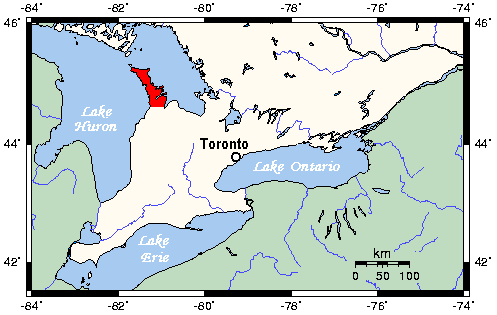
The Bruce Peninsula is located in south-western Ontario and juts out into Georgian Bay. It is known, in Ontario, at least as a beautiful place to visit and is home to both the Bruce Peninsula National Park and Fathom Five National Marine Park as well as several other provincial parks and conservation areas. The Bruce, as it is affectionately known, is also home to the Bruce Power Nuclear Generating Station.

The proposed DGR site is located next to the generating station and you can see what it is expected to look like in the conceptual model below. For reference the DGR is located at 680m below ground (DGSM) within very low permeability limestone and is expected to hold 200,000 cubic metres of waste.

A conceptual model of the Bruce DGR. Source: NWMO's Descriptive Geosphere Site Model
What is the local geology?

The general term that could be used to describe the geology of the Bruce Peninsula is sedimentary, and lots of it! Obviously the geology is more complex than that, although not as much as you might think.

Source: NWMO's Descriptive Geosphere Site Model
The geology for the region, as you can see from the map above, is mostly Devonian and Silurian limestones that get older as you move from west to east. The pink in the top right is the Canadian Shield, which is mostly metasedimentary, metavolcanic or volcanic intrusive rocks. The overall geologic picture is that this is the eastern flank of the Michigan Basin, which was a large sedimentary basin that existed from the Cambrian to the Jurassic and extends from Chicago to Toronto, with Michigan at its centre. The stratigraphy of the basin at the DGR site is pictured below. 
Source: NWMO's Descriptive Geosphere Site Model
As you can see from the figure above the repository horizon will be within the middle Ordovician Cobourg limestone (named after my hometown of Cobourg, Ontario). The Cobourg formation is a clay rich, lime mudstone that has very, very low permeability. The Cobourg is overlain conformably by the Collingwood shale and the upper Ordovician shales that are about 200 metres thick. The shales are then overlain by Silurian and Devonian dolostones and evaporites. 


Is it a good place to store waste? How do we know?

I'll lead with the punchline on this one. The Bruce DGR site is a good place to store low and intermediate level radioactive waste. But, how do we know? The evidence for this comes from many, many research projects that have been conducted across Canada and Europe over the past several years. The overall results outlined in the Descriptive Geosphere Site Model have condensed the work of hundreds of researchers. Overall, this has been a herculean task, but one that has taught us a lot about storing nuclear waste.

Obviously, I can't summarize the thousands of pages of results in one little blog post, but I can give some of the highlights for why we know that the Bruce site will be secure.

- The hydrogeological investigation has found that the hydraulic conductivity of the the Cobourg Formation is 1 x 10^-14 m/s and the overlying 200 metres of shale is 3 x 10^-14 m/s. The underlying Sherman Fall is 9 x 10^-15 m/s. These are some of the lowest hydraulic conductivities ever recorded and make these rocks nearly impenetrable. To put these numbers in perspective it would take water 1 year to move 10 nanometres, which is about the width of a single protein molecule. In a million years water would move about 1 metre (Agosta et.al).

-The rock quality itself is extremely high and there are almost no fractures or faults in the rock whatsoever that could encourage water movement.

- The geochemical evidence from porewater is another way we can tell how secure the rocks at the Bruce DGR are. Porewater was extracted from samples of rock core using a process called vacuum distillation. The ususal recovery was between 0 and 4 mL of water, which is more than enough to analyze for isotopes. The core was then leached in water, which was then analyzed for other elements of interest. Some cores were also analyzed for helium and methane as well. The amount of data that these analyses produced is staggering. The conclusions drawn from these different data sets all agree well and show that the Cobourg limestone is a very secure geologic unit that is bounded on both top and bottom by other very impermeable and stable rock units. The overall conclusion is that the porewater trapped in the rocks is hundreds of millions of years old and has not moved since it was emplaced when the rocks formed in the Ordovician period, 450 million years ago.

So to sum up, the Bruce DGR is a necessary development. There is no question that as time passes and nuclear energy, while it has taken a recent setback, will continue to grow in importance. This can only mean the production of more radioactive waste which only serves to highlight the urgent need to find a safe, long-term storage solution. The Bruce DGR is such a solution due the the highly impermeable nature of the rock units and the physical and geochemical evidence that shows this is a stable and unchanging environment. When looking at the big picture it is easy to see that the geology around us dictates our land usages while also providing us with opportunities to exploit its unique properties serving as a reminder that we are inextricably linked to the geology around us.

Also, please feel free to post any questions that you may have and I'll do my best to answer them.

Matt

References:

NWMO's DGR Website: http://www.nwmo.ca/dgr

NWMO's Descriptive Geosphere Site Model: http://www.nwmo.ca/uploads/DGR%20PDF/Licensing/DGSM.pdf


Agosta, S., Scharf, V., & Herod, M. (2011). Conference Report - The Second Canadian Symposium on Aquitard Hydrogeology. Geoscience Canada, 38(4), 151-153.


All of the information in the post can be obtained freely at the NWMO's website on the Bruce DGR. The opinions expressed in this post are my own and do not represent those of the NWMO, OPG, uOttawa or my direct supervisors.

Monday, May 14, 2012

Uh-Oh

Pinned Image

What can I say...this is hilarious on so many levels and I had to share it. Stay tuned for more serious posts to come. 

Matt